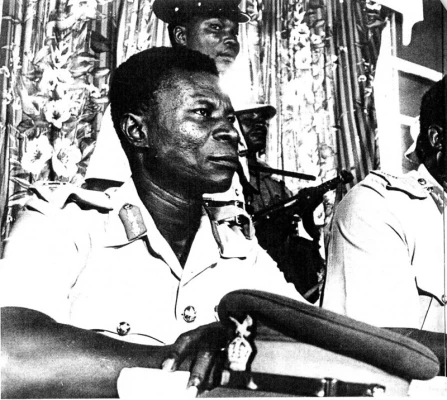
In recent times, public discourse in Ghana have focused on the naming of state edifices after individuals considered national heroes or conversely renaming of state edifices off persons deemed unworthy of such recognition. Unfortunately these discussions have often assumed emotional, political and at times ethnic dimensions, which tend to obscure rather than illuminate the substantive historical issues at stake. However this generation is uniquely positioned to engage these historical questions with the benefit of historical distance and a commitment to dispassionate analysis
It is generally accepted that state edifices should be named after individuals who have made significant contributions to the nation, both to preserve their legacy and to inspire present and future generations to do same. However controversies have ensued in Ghana over the renaming of existing ones. When these proposals arise, public debate frequently degenerate into the uncritical adoption of the dominant narratives without adequate interrogation of the historical context the produced the individuals concerned. The current debate surrounding the proposed renaming of the Kotoka international airport to Accra international airport exemplifies this tendency. While the renaming of the airport may be justified, the dominant rationale advanced by proponents cast Lt-Gen E K Kotoka and his fellow conspirators as traitors and hence underserving of national recognition. History is rarely that simple and will demand a further scrutiny
A prevailing view in the public discourse is that both Dr. Kwame Nkrumah and Lt-Gen Kotoka cannot simultaneously be regarded as national heroes. This view rests on the argument that, Dr. Nkrumah’s unparalleled contribution to Ghana’s independence and African’s decolonisation renders any opposition to him tantamount to opposition to Ghana itself. Indeed there is no doubt that as Ghanaians we derive immense pride from Nkrumah’s legacy as the nation’s first president and a leading figure in Pan-Africanism. Nonetheless with deeper analysis, it is possible to finds applauds for Lt-Gen Kotoka and his co-conspirators to earn them the recognition of the kind currently on a knife edge.
Beyond the numerous developmental achievements between 1958 and 1966, Ghana’s political development exhibited deeply troubling authoritarian/dictatorial tendencies under Dr. Kwame Nkrumah. These years provided painful but instructive lessons that would later inform the drafting of subsequent constitutions, particularly the 1992 constitution. During this period a series of legislative instruments were enacted that severely curtailed civil liberties and undermined democratic governance.
The Deportation Act of July, 1958 empowered the government to deport individuals, labelled as “foreigners”, many of whom were in fact financiers and supporters of opposition parties thereby crippling political opposition and entrenching the dominance of the CPP. The Emergence Act of 1958 granted sweeping powers to suppress political unrest, while the Preventive Detention Act (PDA) of 1958 authorised the arrest and detention without trial for up to five years of persons merely suspected of acting against national security.
Indeed the application of the PDA was extensive and indiscriminate. In 1958 alone thirty-nine members of the Ga Shifimokpe and the United Party (UP) were detained. Nine out of twelve UP members in the Ashanti and Volta regions were also arrested. By 1963, approximately 586 individuals had been detained without trial including prominent opposition figures such a Joe Appiah, Victor Owusu, Kwesi Lamptey and Fred Sarpong. CPP ministers and members of parliament including W A Wiafe and Quaidoo were detained under this Act. Mr. Komla Agbeli Gbedemah, Dr. Nkrumah’s Minister of Finance and close confidant in the early 50s, fled into exile to avoid detention. Most tragically the PDA led to the arrest of Dr. J B Danquah and Mr. Obetsebi Lamptey both of whom died in detention.
The adoption of the 1960 republican constitution further consolidated executive dominance and abuse. Under Article 55, the President was vested with extensive powers to rule by decrees. Article 44 empowered the president to appoint and dismiss the Chief Justice, effectively subordinating the judiciary to executive. Additionally article 44(clause 51) placed control over appointments, promotions, transfers and dismissals within the public and judicial services firmly in the hands of the President. Article 24 granted the President absolute discretion to assent to, partially assent to or reject all bill passed by Parliament. In effect, constitutional safeguards against executive abuse were severely weakened if not non-existent. This justified the scholarly description of Dr. Kwame Nkrumah as a constitutional dictator.
These authoritarian tendencies intensified following the Kulungugu bombing incident. Senior government officials including Tawiah Adamafio (Minister of Information), Kofi Crabbe (Executive Secretary to the CPP) and Ako Adjei (Minister for Foreign Affairs) were arrested and tried. After their acquittal, Chief Justice Sir Arku Korsah and the judges who presided over the cases were dismissed. A retrial was ordered and the accused were subsequently convicted and imprisoned. Such actions fundamentally undermined the judicial independence and the rule of law under Dr. Kwame Nkrumah. By 1964, a plebiscite formally established Ghana as one-party state, with the CPP as the sole legal political party and its flag elevated as the national flag of Ghana. Parliamentary democracy was effectively abolished as Members of Parliament (MPs) were appointed by presidential announcements. In some cases, person appointed as MPs had no knowledge of the constituencies they purportedly represented. Political participation was therefore extinguished, dissent criminalised and Dr. Kwame Nkrumah merely ruled as the President for life
Within this context, conventional democratic mechanisms for political change were non-existent. Ghanaians lived under a climate of fear, with no lawful avenues to challenge or replace an increasingly repressive government. It is in these circumstances that the 1966 coup ought to be assessed. While coups are inherently undemocratic, the overthrow of Dr. Kwame Nkrumah’s government can be interpreted at the time as the needed evil, to respond to a constitutional order that had closed all legitimate avenues for change or reforms. Why then should those who dared to take the bold step not be applauded?
Significantly, the aftermath of the coup led to the drafting of the 1969 constitution which restored political participation denied the populace by 1966. No subsequent democratic government has attempted to reintroduce legal instruments comparable to the PDA or replicate the concentration of executive power entrenched under the 1960 constitution. Indeed the 1992 constitution, drawing lessons from this period, deliberately entrenched safeguards against executive tyranny and sought to prevent the emergence of another “constitutional dictator”. This insulates it from any justification of an overthrow. Its longevity speaks volumes of this fact.
In light of this historical record, the hurried portrayal of Lt-Gen Kotoka and his colleagues as traitors is overly simplistic. The history suggests that the Lt-Gen Kotoka debate should not be reduced to a binary choice between hero and traitor. A balanced assessment should recognise the monumental achievements of Dr. Nkrumah and the authoritarian excesses of his later rule. It is equally vital to recognise that those who opposed the system were responding to a genuine democratic crisis and have been vindicated over time as no subsequent republic has replicated the first.
Therefore a discussion of this nature must not be guided by the moral absolute view but by a careful historical reasoning. Simplistic narratives do not strengthen national unity, an honest engagement with our past does.
About the writer; Atura Ayam is a history teacher and a student of politics, akelemturaayam@gmail.com
EDITOR’S NOTE: Views expressed in opinions from our Contributors do not represent Mike 105.3 FM.