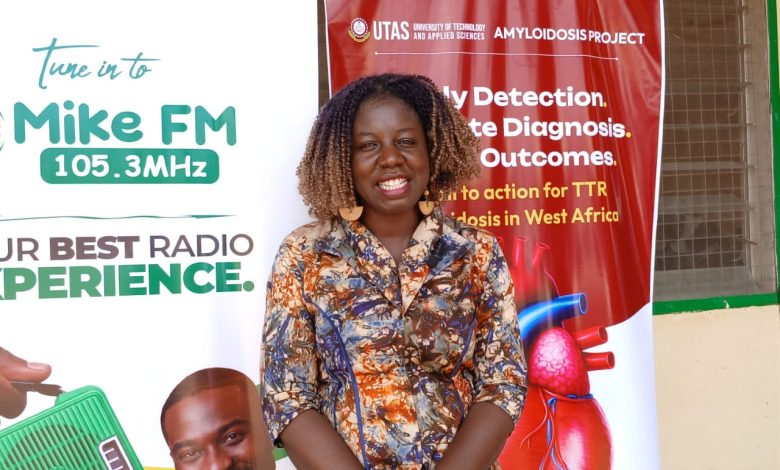
Dr. Rita Suhuyini Salifu, Principal Investigator for the University of Technology and Applied Sciences (UTAS) Navrongo Transthyretin (TTR) Amyloidosis Program, has identified delayed diagnosis as the biggest challenge in tackling the disease.
Speaking at a clinical awareness seminar on TTR Amyloidosis held at the Navrongo Community Nursing Training College on Tuesday, April 28, Dr. Salifu stressed the urgent need for intensified research and improved training for healthcare workers to enhance early detection.
According to her, TTR Amyloidosis is a complex multisystem disorder that often mimics other medical conditions, making it difficult to diagnose accurately.
“We don’t have much work done on it because awareness is low. Many cases may have been misdiagnosed or not detected at all because the disease presents like other conditions. It is multisystemic, it can appear like a heart attack or other illnesses.” She explained.
Dr. Salifu further noted that research indicates a strong genetic component to the disease, particularly in West Africa, where the hereditary gene associated with TTR Amyloidosis is more prevalent.
“Studies show that part of the condition is hereditary, and the gene is common in West Africa. This increases the likelihood of developing the disease among people from this region.”
She emphasized that raising awareness is critical to improving detection and outcomes.
“For any disease, awareness must come first before detection improves. Otherwise, people may pass away without ever knowing the true cause of their condition.” She added.
Mike 105.3FM | Navrongo | Alexander Bombande