UTAS celebrates 7th congregation, appeals for support to expand infrastructure and staffing
University maintains top-10 national research ranking, graduates 158 postgraduate students and pushes ahead with plans to launch a School of Medicine.
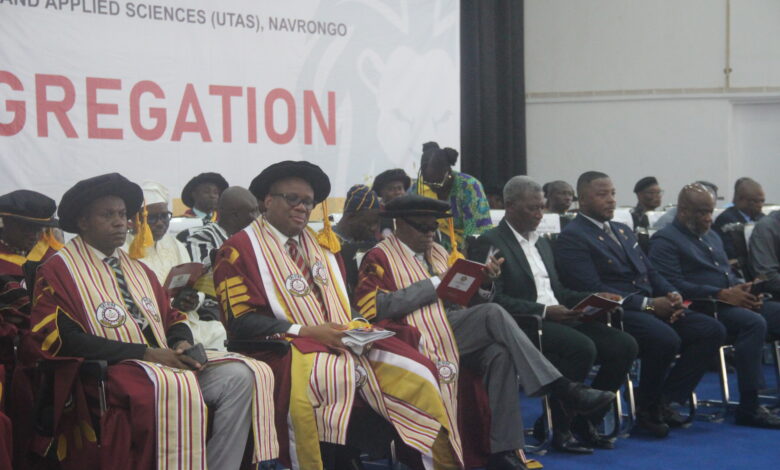
The University of Technology and Applied Sciences (UTAS) has graduated 158 postgraduate students at its 7th Congregation Ceremony in Navrongo, while appealing for increased government support to address infrastructure and staffing challenges as it prepares to establish a School of Medicine.
The graduation ceremony, held on Saturday, June 13, brought together university officials, traditional leaders, government representatives, academic staff, graduates, and their families to celebrate the achievements of students who successfully completed various postgraduate programmes.
Chairman of the UTAS Governing Council, Professor Stephen Kendie, described the occasion as a moment of pride for both the university and the graduating class, commending the graduates for their resilience and dedication throughout their academic journey.
He noted that UTAS continues to make significant progress in research and academic excellence, maintaining its position as the 10th-ranked university in Ghana in research output according to the AD Scientific Index for two consecutive years.
“UTAS is providing human resources in science and technology for both industry and STEM educational institutions in the country,” he stated.
Professor Kendie, however, expressed concern over the university’s infrastructure and financial constraints, describing UTAS as a resource-constrained institution struggling to expand facilities and provide adequate teaching and learning infrastructure.
He appealed to the Ghana Tertiary Education Commission (GTEC) and government to consider the challenges facing smaller universities, particularly in relation to staffing approvals and funding.
According to him, UTAS currently relies heavily on internally generated funds to pay part-time lecturers in critical programmes such as Nursing and Medicine, a situation he described as unsustainable.
Addressing the graduates, Professor Kendie urged them to serve as worthy ambassadors of the institution by demonstrating professionalism, integrity, and commitment to national development.
“The degrees you receive today are not the conclusion of your intellectual journey. They are just a commencement,” he advised.
Delivering the valedictory address on behalf of the graduating class, Valentine Aveyom described postgraduate education as a challenging but rewarding experience that demanded resilience, sacrifice, and perseverance.
He acknowledged the support of lecturers, supervisors, families, and friends, saying their encouragement played a critical role in the success of the graduates.
Aveyom urged his fellow graduates to use the knowledge and skills acquired at UTAS to solve societal problems, drive innovation, and contribute meaningfully to national development.
“As we leave UTAS, let us not confine our knowledge to academic journals and research repositories. Let us apply what we have learned to improve lives and strengthen institutions,” he said.

The Vice-Chancellor, Professor Albert Luguterah, presenting his report, disclosed that 14 students graduated with Doctor of Philosophy (PhD) degrees, 91 with Master of Philosophy (MPhil) degrees, five with Master of Education (MEd) degrees, and nine with Master of Public Health (MPH) degrees, among other postgraduate qualifications.
The university also highlighted several achievements, including the ongoing construction of a two-storey lecture hall complex with a seating capacity of 480 students, expected to be completed in November 2026.
Management further announced that GETFund has approved the continuation of two previously stalled infrastructure projects, including a four-storey lecture hall and office complex and a four-storey laboratory facility.
He also revealed that significant progress has been made toward establishing its School of Medicine, with plans to admit the first cohort of medical students during the 2026/2027 academic year.
Additionally, the university has been selected as a regional hub for the government’s One Million Coders Initiative and has received 200 laptops to support the programme.
Despite these gains, university authorities identified inadequate laboratory facilities, poor road infrastructure, staff shortages, and an aging vehicle fleet as major challenges requiring urgent intervention.
The university appealed to government, development partners, and other stakeholders to support its efforts to expand infrastructure, improve teaching and learning conditions, and strengthen research and innovation.
Mike 105.3FM | Navrongo | Abiiro Samuel Atule